Enterprise AI Governance & AIOps
•06 min read
Enterprise AI pilots are failing at a catastrophic rate. MIT's State of AI in Business 2025 report reveals that 95% of custom enterprise AI tools never transition from pilot to production. CIO.com found that 88% of AI pilots fail to reach production deployment. Gartner predicts that over 40% of agentic AI projects will be cancelled outright by 2027. The problem isn't the technology—it's that most organizations are building AI agents on fundamentally flawed architectural assumptions.
Most executives read these failure rates as implementation challenges or talent shortages. But the data reveals something more fundamental: enterprises are treating AI agents like traditional software applications when they require entirely different infrastructure paradigms. The 5% that succeed understand this architectural distinction from day one.
TL;DR
Enterprise AI pilots fail because organizations build them on traditional software architectures that cannot support autonomous, learning systems at production scale
The companies succeeding—AWS, Google, and Microsoft among hyperscalers, plus specialized platforms—design for agent-specific requirements: continuous learning, multi-model orchestration, and real-time adaptation
The architectural gap creates a "demo trap" where impressive pilots cannot scale because their underlying infrastructure lacks the observability, governance, and integration capabilities production demands
Forward-thinking enterprises are adopting full-stack, cloud-agnostic platforms that treat AI agents as first-class citizens rather than retrofitting traditional application stacks
The window for architectural decisions is closing rapidly—organizations that don't address this foundation will find themselves locked into expensive, restrictive vendor ecosystems or trapped in perpetual pilot mode
Consider the experience of a Fortune 500 financial services company that built an AI agent for loan processing. The pilot processed 1,000 applications with 94% accuracy in a controlled environment. Six months later, the project was cancelled. The agent couldn't handle edge cases, lacked audit trails for regulatory compliance, and required manual intervention for 40% of real-world scenarios.
This pattern repeats across industries because pilots operate in architectural sandboxes that bear no resemblance to production environments. Traditional application architectures assume predictable inputs, deterministic outputs, and linear scaling. AI agents require continuous model updates, multi-step reasoning chains, and adaptive behavior based on contextual learning.
The MIT study identifies the core issue: most enterprise AI systems lack memory, contextual adaptation, and continuous improvement capabilities. They're deployed as static systems in dynamic environments. A customer service AI agent that cannot remember previous interactions or adapt its responses based on customer sentiment will fail the moment it encounters real-world complexity.
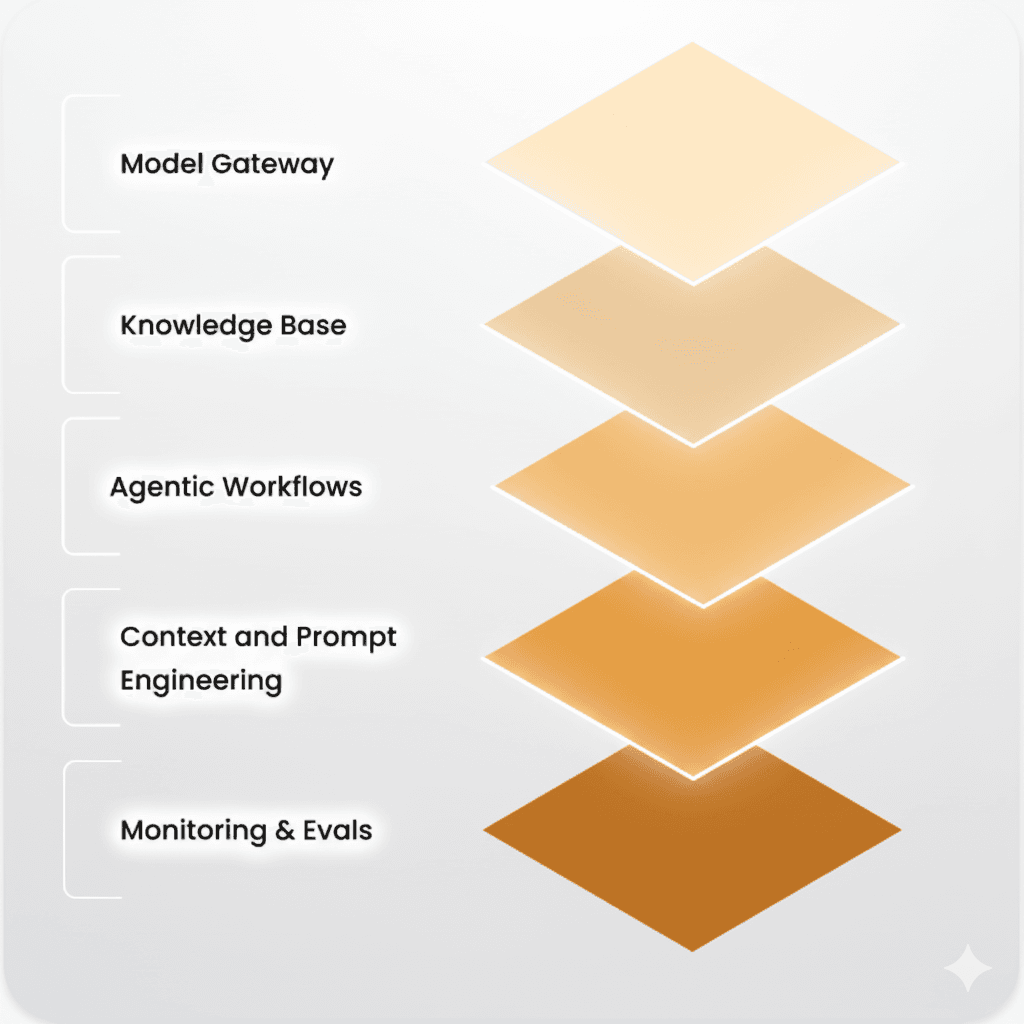
But the architectural requirements go deeper than individual agent capabilities. Production AI systems need orchestration layers that can manage multiple models simultaneously, observability frameworks that can trace decision paths across complex workflows, and governance systems that can enforce compliance without breaking agent autonomy. Traditional application stacks weren't designed for these requirements.
The same financial services company that failed with their custom loan processing agent later succeeded using AWS Bedrock's managed infrastructure. The difference wasn't the AI models—it was the underlying platform architecture. Bedrock provides model management, automatic scaling, built-in observability, and compliance frameworks designed specifically for AI workloads.
This reveals why hyperscaler platforms like AWS Bedrock, Google Vertex AI Studio, and Azure AI Foundry dominate successful AI deployments. They've architected their platforms around agent-specific requirements from the ground up. When Vertex AI Studio manages model versioning, handles prompt optimization, and provides real-time monitoring, it's solving the infrastructure problems that doom custom implementations.
The architectural advantage extends to specialized platforms like DotKonnekt's Vertical AI Studio, which combines full-stack AI capabilities—model management, LLM operations, agent orchestration, and observability—in cloud-agnostic, Kubernetes-based infrastructure. These platforms succeed because they treat AI agents as first-class citizens rather than applications running on traditional compute infrastructure.
But here's where the infrastructure divide becomes a strategic trap. Organizations that start with hyperscaler platforms often achieve initial success, then discover they're locked into proprietary ecosystems with escalating costs and limited portability. The ease of deployment masks long-term architectural constraints that become apparent only at scale.
The architectural challenge runs deeper than infrastructure—it's about fundamental system design philosophy. Traditional enterprise software is built on the assumption that systems should be predictable, auditable, and deterministic. AI agents require the opposite: they must learn, adapt, and evolve their behavior based on new data and changing contexts.
Consider how Google's AI agents in Gmail automatically categorize emails and suggest responses. The system continuously learns from user interactions, updates its models based on new patterns, and adapts its behavior without human intervention. This requires an architecture that can handle continuous model updates, A/B testing of different agent behaviors, and real-time performance optimization.
Most enterprise AI pilots fail because they're built on static architectures that cannot support this continuous learning loop. The loan processing agent that worked perfectly in testing failed in production because it couldn't adapt to new loan types, changing regulations, or evolving customer behaviors. It was a snapshot of intelligence, not a learning system.
The MIT research emphasizes this point: the pilot-to-production divide stems from a fundamental learning gap. Consumer AI tools like ChatGPT succeed because they learn from every interaction. Enterprise AI agents fail because they're deployed as static systems that cannot evolve with their environment.
This architectural requirement—supporting continuous learning while maintaining enterprise governance—represents the most complex challenge in AI deployment. It requires platforms that can manage model lifecycles, handle data drift, maintain audit trails, and ensure compliance while allowing agents to adapt and improve autonomously.
The architectural challenges reach their peak in the governance paradox: how do you maintain enterprise control over systems designed to operate autonomously? This tension has killed more AI pilots than any technical limitation.
Financial services companies face this paradox acutely. AI agents must make autonomous decisions to provide value, but every decision must be auditable for regulatory compliance. Healthcare organizations need AI agents that can adapt to new medical research, but they cannot allow agents to make recommendations outside established protocols. Manufacturing companies want AI agents that can optimize supply chains in real-time, but they need guarantees that agents won't make decisions that violate safety standards.
Traditional governance frameworks assume human oversight at decision points. AI agent architectures must embed governance into the system itself—through model constraints, decision boundaries, and automated compliance checking. This requires platforms that can provide real-time observability into agent decision-making while maintaining the autonomy that makes agents valuable.
The companies succeeding at scale—from AWS's enterprise customers to organizations using specialized platforms like DotKonnekt—have solved this paradox through architectural design. They use platforms that provide built-in compliance frameworks, automated audit trails, and governance controls that operate at the infrastructure level rather than requiring human intervention.
But the governance paradox reveals the highest stakes in the architectural decision. Organizations that cannot solve this balance will never move AI agents into mission-critical workflows. They'll remain trapped in low-risk, low-value use cases that don't justify the investment in AI infrastructure.
The architectural requirements for production AI agents are not getting simpler—they're becoming more complex as agents become more sophisticated and enterprises demand higher levels of integration and governance. Organizations that defer architectural decisions while running pilots on inadequate infrastructure are not just risking project failure—they're risking strategic obsolescence.
Gartner's prediction that 40% of agentic AI projects will be cancelled by 2027 reflects this architectural reality. As AI agents become more capable, the gap between pilot-friendly and production-ready infrastructure will widen. Organizations building on traditional application architectures will find themselves increasingly unable to bridge this gap.
The window for making foundational architectural decisions is closing because the switching costs are rising. Moving from a hyperscaler platform to a cloud-agnostic solution becomes exponentially more expensive as data volumes grow and integrations multiply. Retrofitting governance and observability into existing AI systems becomes nearly impossible as agent complexity increases.
Forward-thinking enterprises are making architectural decisions now, before they're locked into suboptimal platforms. They're choosing full-stack, cloud-agnostic solutions that provide the flexibility to evolve with changing requirements while maintaining the control and governance that enterprise environments demand.
The 5% of organizations that successfully deploy AI agents at production scale share one characteristic: they understood the architectural requirements before they built their first pilot. They didn't treat AI agents as applications—they treated them as a new category of system that requires purpose-built infrastructure.
The 95% failure rate for enterprise AI pilots isn't a technology problem or a talent problem—it's an architecture problem. Organizations are building AI agents on infrastructure designed for traditional applications, then wondering why they can't scale to production. The solution isn't better models or more data—it's platforms designed specifically for autonomous, learning systems that can operate within enterprise governance frameworks.
The companies succeeding at AI deployment understand that agents require fundamentally different infrastructure paradigms. They're investing in full-stack platforms that provide model management, continuous learning capabilities, real-time observability, and built-in governance. They're choosing cloud-agnostic solutions that avoid vendor lock-in while providing the enterprise-grade security and compliance that production environments demand.
The architectural decisions being made today will determine which organizations can harness AI agents for competitive advantage and which remain trapped in pilot purgatory. The question isn't whether AI agents will transform business operations—it's whether your organization has the architectural foundation to make that transformation possible.
MIT Sloan, State of AI in Business 2025 (August 2025)
CIO.com, "88% of AI pilots fail to reach production — but that's not all on IT" (March 2025)
Gartner, Survey of 782 I&O Leaders on AI ROI Expectations (2025)
Gartner, Prediction on Agentic AI Project Cancellations (June 2025)
Deloitte, 2025 Tech Trends Report — Pilot Purgatory Phenomenon
Forbes, "Why 95% Of AI Pilots Fail, And What Business Leaders Should Do Instead" (August 2025)